
WELCOME BONUS 300%
UP TO €2000 + 100
FREE SPINS
UP TO €2000 + 100
FREE SPINS
Home → Roulette
Roulette at Spinit Casino
50 Euro Budget at a 1 Euro Table
A 50 Euro bankroll on a table with a 1 Euro minimum stake allows for fifty initial spins on European Roulette, which features a house edge of 2.70% and an RTP of 97.30%. This specific configuration provides the longest theoretical playtime compared to American variants that carry a higher 5.26% edge. Consequently, the player retains more capital over time, reducing the rate of depletion during a session. The Straight bet pays 35:1, offering substantial returns when numbers hit.
The contribution of this table game to the bonus wagering requirement is limited to just 10%, significantly slowing progress toward unlocking the 300% welcome bonus up to €2,000 plus 100 free spins. Players must generate 4,000 Euros in turnover to clear a maximum 2,000 Euro bonus, meaning only 400 Euros of actual betting activity counts toward this goal. This restriction makes the low-stakes strategy less efficient for clearing promotional funds. Alternative high-RTP slots would accelerate the release of locked winnings.
Using a flat-betting approach on Red or Black (1:1) at 1 Euro per spin extends the session duration by minimizing variance exposure against the 2.70% mathematical advantage. Each losing spin reduces the balance by exactly one unit, while wins restore it without altering the fundamental expectation of negative drift. Over thousands of spins, the expected loss equals 2.70% of total volume, resulting in approximately 1.35 Euros lost per hundred Euros wagered. This predictable erosion defines the long-term cost of participation.
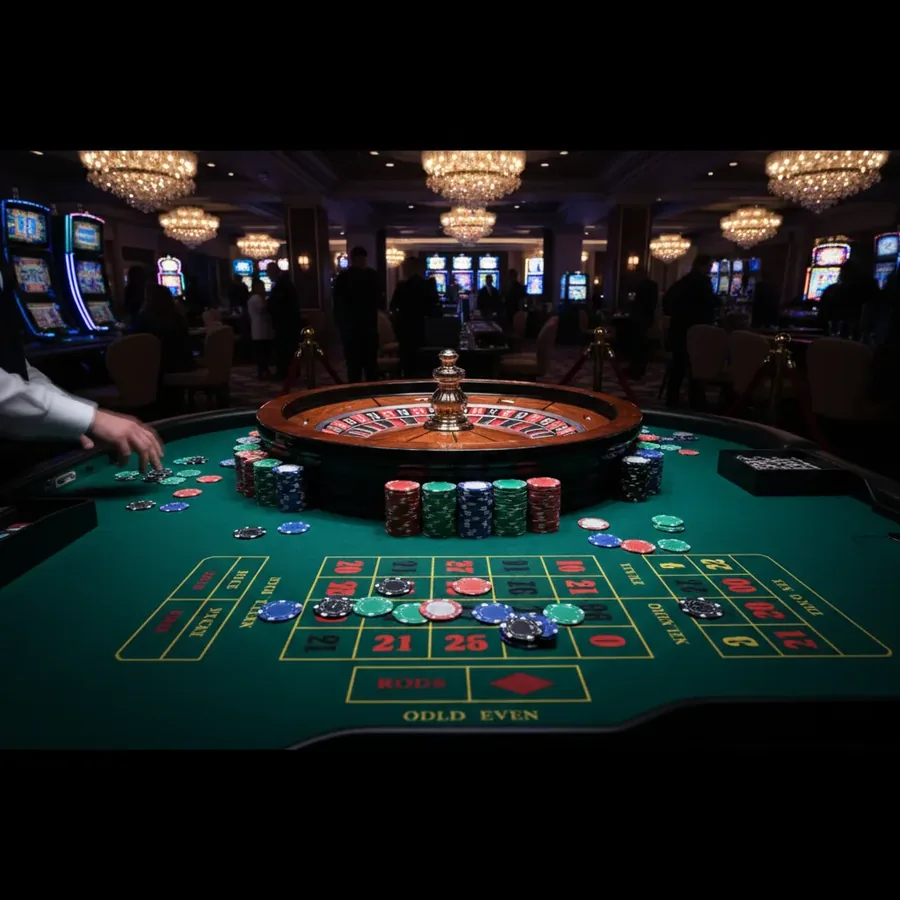
How Much Budget Withstands 2.70 Percent House Edge
The 2.70% house edge on European Roulette dictates that for every 100 Euros wagered, the casino retains an average of 2.70 Euros as statistical profit. This figure derives from the single zero pocket on the 37-sector wheel, creating an RTP of 97.30% for standard outside bets like Red/Black or Odd/Even. A budget of 100 Euros theoretically supports 3,700 spins at a 1 Euro stake before complete exhaustion under idealized conditions. This mathematical reality establishes the baseline risk profile for all roulette players.
Comparing this to the American variant reveals a stark difference: the double zero increases the house edge to 5.26%, nearly doubling the expected loss rate. While the payout structure remains identical with Straight bets paying 35:1, the additional zero sector drastically accelerates bankroll depletion. A player facing the 5.26% edge loses roughly twice as much money per hour as their counterpart at the European table. This disparity makes the European wheel the mathematically superior choice for preserving capital.
The Five Number Bet on the American wheel represents a critical exception, carrying a punitive 7.89% house edge due to its 6:1 payout covering five sectors. This specific wager is identified as the worst option on the floor, offering poor value even compared to other standard bets. No equivalent exists on the European or French wheels, where the lowest available edge remains 2.70% for inner bets without La Partage. Avoiding this trap preserves the integrity of the remaining budget against aggressive mathematical disadvantages.
RTP vs. House Edge: Same Number Differently
An RTP of 97.30% corresponds directly to a house edge of 2.70%, representing the inverse relationship between player return and casino retention. On a European Roulette wheel with 37 sectors, every 100 Euros wagered returns 97.30 Euros to players in the long run, while the operator keeps 2.70 Euros. This metric applies uniformly across all standard bets, including Dozen wagers paying 2:1 and Corner bets paying 8:1. Understanding this equivalence helps players recognize that lower edges yield higher theoretical returns.
French Roulette with La Partage improves the player position by reducing the effective house edge to 1.35% for even-money bets, despite sharing the same 37-sector physical layout. When the ball lands on zero, half the stake on Red/Black or Odd/Even is returned, effectively halving the loss frequency on these specific outcomes. This rule creates an RTP of 98.65% for those particular wagers, making it the most favorable environment for conservative play. Inner bets remain unaffected by this benefit, retaining the standard 2.70% edge.
Lightning Roulette from Evolution maintains the base RTP of 97.30% but introduces volatile multipliers ranging from 50x to 500x on up to five Lightning Numbers. These random enhancements do not alter the underlying mathematical expectation of the core game, which still operates on the standard European wheel rules. Players risking stakes between 0.20 and 5,000 Euros face the same 2.70% disadvantage on non-multiplied straight bets. The side mechanics add excitement without changing the fundamental cost of play defined by the original edge.
Which Table Fits a 30 Euro Balance
A 30 Euro balance restricts viable options to tables with minimum stakes of 0.10 Euros or 0.20 Euros, such as Quantum Roulette Live or Ultimate Roulette. Playtech’s Quantum variant offers multipliers up to 500x on one to five numbers, allowing small bets to potentially yield significant payouts despite the 2.70% house edge. Ezugi’s Ultimate Roulette similarly provides multipliers up to 1,000x, with potential doublings reaching 2,000x for enhanced win scenarios. These live dealer formats accommodate tight budgets while offering high-variance opportunities absent in standard digital versions.
Standard European Roulette requires a minimum stake that may exceed 30 Euros on many platforms, forcing players to either increase their deposit or abandon the game. If a 1 Euro minimum applies, the player can execute only thirty spins, leaving no margin for error or variance fluctuation. The Straight bet pays 35:1, meaning a single winning spin restores the entire balance plus profit, but consecutive losses result in immediate bankruptcy. This lack of buffer makes the 30 Euro threshold precarious for traditional table games.
Live dealer games often impose higher minimums than RNG counterparts, yet some providers allow micro-stakes starting at 0.10 Euros. Quantum Roulette Live permits entries from 0.10 to 5,000 Euros, providing ample flexibility for a constrained bankroll. The RTP remains constant at 97.30%, ensuring that the cost of play aligns with standard expectations regardless of the multiplier feature. Selecting these low-limit tables ensures access to premium entertainment without violating financial constraints.
Check Table Limit Before First Progression Starts
Progressive betting systems like Martingale require exponential stake increases after losses, quickly approaching maximum table limits and exhausting fixed bankrolls. A typical progression starting at 1 Euro reaches 128 Euros after seven consecutive losses, testing the upper bounds of many standard European Roulette tables. If the table imposes a maximum bet limit, the player cannot recover previous losses with a single winning spin, breaking the system’s logic. This structural barrier renders most progression strategies ineffective against the immutable 2.70% house edge.
The 300% welcome bonus up to €2,000 plus 100 free spins imposes strict wagering requirements that complicate high-stakes progression attempts. Only 10% of table game contributions count toward the turnover target, meaning players must wager ten times more than they would on slots to clear the bonus. Attempting to clear 4,000 Euros in turnover using high-variance roulette bets exposes the player to significant ruin risk before achieving eligibility. This constraint discourages aggressive staking patterns designed to maximize short-term gains.
Table limits vary significantly between providers, with some live casinos capping bets at 5,000 Euros while others restrict them to 100 Euros. Players must verify these ceilings before initiating any betting sequence to ensure their planned progression remains viable throughout a session. Exceeding the maximum stake results in voided bets and potential account restrictions, eliminating any strategic advantage gained through careful planning. Pre-session verification protects both the bankroll and the player’s standing with the operator.
Roulette bet types at a glance
| Bet | Payout | Win Chance | Numbers Covered | House Edge |
|---|---|---|---|---|
| Roulette Europäisch (einfache Null, 37 Sektoren) | Straight 35:1, Split 17:1, Street 11:1, Corner 8:1, Six Line 5:1, Dozen 2:1, Column 2:1, Rot/Schwarz 1:1, Odd/Even 1:1, 1-18/19-36 1:1 | 97.30% | 37 Sektoren (1–36 + 0); Auszahlungen wie für 36 Sektoren – daher konstanter Edge auf ALLE Wetten | 2.70% |
| Roulette Amerikanisch – Five Number Bet (0, 00, 1, 2, 3) | Five Number 6:1 (deckt 5 von 38 Sektoren) | 92.11% | Einzige Wette am amerikanischen Rad mit Edge über 5,26% – „Fallenwette“. Kein Äquivalent am europäischen Rad | 7.89% |
| Roulette Französisch, innere Einsätze (La Partage gilt nicht) | Straight 35:1, Split 17:1, Street 11:1, Corner 8:1, Six Line 5:1, Dozen 2:1, Column 2:1 | 97.30% | Rad gleich (37 Sektoren), aber La Partage/En Prison gilt nicht für innere Einsätze – Edge bleibt europäisch | 2.70% |
| Roulette Amerikanisch (doppelte Null, 38 Sektoren) | Straight 35:1, Split 17:1, Street 11:1, Corner 8:1, Six Line 5:1, Dozen 2:1, Column 2:1, Rot/Schwarz 1:1 | 94.74% | 38 Sektoren (1–36 + 0 + 00); Auszahlungen wie beim europäischen Rad, aber der zusätzliche Sektor verdoppelt den Hausvorteil | 5.26% |
| Roulette Französisch mit La Partage (gerade Chancen) | Rot/Schwarz 1:1 (bei 0 Rückerstattung 50%), Odd/Even 1:1, Low/High 1:1; Innere Einsätze ohne La Partage: Straight 35:1, Split 17:1, Street 11:1, Corner 8:1 | 98.65% | Bei 0 wird die Hälfte des Einsatzes auf gerade Chancen zurückerstattet (Rot/Schwarz, Pair/Impair, Manque/Passe). En Prison gibt denselben 1,35%. Regel gilt NUR für gleiche Einsätze | 1.35% |
When Does the Lock for Risk Bets Apply?
The Lightning Roulette table by Evolution Gaming operates with a 0.20 EUR to 5,000 EUR stake range and applies standard European wheel rules. The payout structure mirrors standard roulette with straight bets paying 35:1 and even-money options at 1:1. This baseline applies before the special lightning multipliers activate on selected numbers. Players should note that the base game mechanics remain consistent regardless of multiplier presence.
36 Instead of 37: The Math Behind 35:1
A straight bet covering a single number pays 35:1 across all roulette variants, including the American wheel with 38 sectors. This fixed payout creates a mathematical discrepancy because the American wheel includes an additional double zero sector compared to the European version. Consequently, the house edge rises to 5.26% on the American wheel despite the identical payout ratio. The extra green pocket reduces the player's probability of winning without altering the reward amount.
How Much Bonus Wager for 100 Euro Roulette Bet?
The welcome bonus offers 300% up to €2,000 plus 100 free spins for new registrants. Table games contribute only 10% toward fulfilling the wagering requirement attached to this offer. A 100 EUR wager on a roulette table therefore counts as just 10 EUR toward the total turnover target. This low contribution rate significantly extends the time required to clear the bonus funds compared to slot contributions.
Which Bets Count Towards 10 Percent?
All bets placed on the Ultimate Roulette table by Ezugi fall under the 10% contribution category for bonus clearance. Stake limits on this specific table range from 0.10 EUR to 5,000 EUR per round. Even high-stakes wagers on inside combinations like splits or corners adhere to this reduced weighting. The entire game type is treated uniformly regardless of the specific chip placement on the layout.
Mobile Tables: Which Betting Fields Become Smaller
The Quantum Roulette Live variant by Playtech features multipliers up to 500x on one to five numbers per spin. Mobile interfaces typically compress these betting fields to accommodate smaller screen dimensions while maintaining functionality. The minimum bet remains at 0.10 EUR on mobile devices, matching the desktop entry threshold. Visual adjustments do not alter the underlying RTP of 97.30% available across all device types.
Table Limit 500 Euro Stops Every Doubling
The maximum bet at Quantum Roulette Live is capped at 5,000 EUR, a threshold that fundamentally alters high-stakes progression strategies. This ceiling prevents the exponential growth typical of Martingale systems, forcing players to reset their wagering cycles much earlier than anticipated. Consequently, a player cannot recover losses through simple doubling on a single spin without exceeding the table's operational boundaries. The limit applies uniformly across all standard and quantum-modified bets, ensuring consistent risk management for all participants.
Roulette Europäisch offers a house edge of only 2.70%, which remains constant regardless of the specific bet placed on the wheel. This mathematical stability means that even with a 500 Euro cap, the expected loss per hour is predictable based on volume. Players relying on large stakes must account for this fixed percentage when calculating their total bankroll requirements over extended sessions. The edge does not decrease with higher wagers, maintaining the casino's statistical advantage regardless of the betting amount involved.
Playtech provides Quantum Roulette Live with multipliers up to 500x, creating volatile outcomes that interact sharply with the 5,000 EUR table limit. A winning straight bet could yield a massive payout, but the initial stake restriction limits the absolute maximum win potential significantly. This dynamic requires careful calculation of unit sizes to maximize the utility of each allowed wager within the strict financial framework. The combination of high multipliers and low table limits creates a unique risk profile distinct from traditional roulette variants.
Calculate Payout: Corner 8:1 Plus Bet
A Corner bet covers four numbers and pays at odds of 8:1, providing a straightforward return structure for intermediate risk tolerance. When a player wagers 10 Euros on a corner, the total payout upon success amounts to 90 Euros, comprising the original stake plus 80 Euros in profit. This calculation demonstrates the linear relationship between the bet size and the returned funds, independent of any external bonus conditions. The payout ratio remains fixed across European, American, and French variants, ensuring consistency in reward mechanics for this specific wager type.
The Straight bet pays 35:1, offering significantly higher returns than the Corner bet but covering only a single number on the wheel. Comparing the two reveals that the Corner bet provides a more frequent but smaller reward, while the Straight bet offers sporadic large wins. This difference influences the overall volatility of the game, as players must adjust their bankroll management strategies accordingly. Understanding these ratios is essential for evaluating the true cost of play versus the potential reward structures available.
Bonus turnover requirements often assign different contribution rates to various games, impacting how quickly winnings can be withdrawn or reinvested. Table games typically contribute only 10% toward meeting the 40x wagering requirement attached to the welcome bonus package. This low contribution rate means that profits generated from Corner or Straight bets must be significantly larger to clear the bonus conditions efficiently. Players should factor in this reduced credit value when planning their exit strategy from promotional offers.
37 Pockets vs. 38 Pockets: The Difference
European Roulette features a wheel with 37 pockets, including a single zero, which establishes a house edge of 2.70% on all bets. This configuration ensures that every wager, from simple red/black to complex combinations, faces the same mathematical disadvantage over time. The presence of only one green slot reduces the probability of losing compared to wheels with additional zeros, making it statistically preferable for long-term play. Players benefit from this lower edge by retaining a higher portion of their bankroll during extended gaming sessions.
American Roulette contains 38 pockets due to the addition of a double zero, increasing the house edge to 5.26% across most wagers. This nearly doubled disadvantage significantly accelerates bankroll depletion, making the variant less favorable for strategic players seeking sustained engagement. The Five Number Bet on the American wheel presents an even steeper edge of 7.89%, acting as a notorious trap for inexperienced gamblers. Avoiding this specific bet is crucial for minimizing losses in the American variant, given its uniquely high mathematical penalty.
French Roulette with La Partage maintains the 37-pocket structure but refunds half the stake on even-money bets when zero appears. This rule effectively halves the house edge on those specific wagers to 1.35%, offering the best possible odds available in standard roulette formats. However, this benefit applies exclusively to outside bets like Red/Black or Odd/Even, leaving inner bets unaffected by the refund mechanism. Players must distinguish between these rule sets to accurately assess their expected return on investment for each game type.
D'Alembert and Fibonacci Against the Same Table Limit
The D'Alembert system involves increasing the stake by one unit after a loss and decreasing it by one unit after a win, aiming for equilibrium. With a table limit of 5,000 EUR, this progressive strategy can withstand longer losing streaks than exponential methods before hitting the cap. However, the slow growth rate means recovery from significant deficits requires many more spins compared to aggressive doubling systems. Players must monitor their bankroll closely to ensure they do not exhaust funds before achieving the necessary balance of wins and losses.
Fibonacci sequences dictate betting patterns based on the sum of the two preceding numbers, creating a slower escalation than the Martingale approach. Starting with a base unit, the sequence progresses as 1, 1, 2, 3, 5, 8, and so forth, limiting exposure during downturns. This gradual increase allows players to remain within the 5,000 EUR table limit for extended periods, reducing the risk of premature termination. The system relies on the assumption that wins will eventually occur to offset previous losses, though no guarantee exists for such outcomes.
Both systems operate under the constraint of the 10% table game contribution rate toward the 40x wagering requirement for the 300% bonus. This means that profits generated through these progressive strategies are heavily penalized in terms of bonus clearance efficiency. Players must generate substantially larger volumes of play to meet the turnover target, increasing the likelihood of encountering the house edge. The mathematical reality of the game ultimately outweighs the structural benefits of any betting progression method employed.
Live Table vs RNG Table: Rounds per Hour
Lightning Roulette hosted by Evolution delivers an average of approximately 60 rounds per hour, driven by the speed of digital ball release and instant result processing. This high velocity allows players to experience more betting opportunities in a shorter timeframe compared to physical dealer tables. The inclusion of random multipliers adds complexity to each spin, requiring slightly more attention but maintaining a brisk pace throughout the session. Players seeking rapid action can leverage this speed to test strategies more frequently within a limited time window.
Quantum Roulette Live by Playtech operates at a similar pace, offering roughly 60 rounds per hour with integrated quantum multipliers up to 500x. The live dealer interaction adds a social element, but the underlying mechanics remain optimized for fast gameplay without unnecessary delays. This consistency in round frequency ensures that players can maintain a steady flow of bets, crucial for managing bankroll volatility over time. The hybrid nature of the game combines the trust of live streaming with the efficiency of automated result generation.
RNG versions of European Roulette typically run even faster, potentially exceeding 100 rounds per hour due to the absence of human dealers and physical equipment. This increased tempo amplifies the impact of the 2.70% house edge, leading to quicker bankroll erosion if betting patterns remain unchanged. Players must adjust their stake sizes accordingly to mitigate the accelerated loss rate inherent in high-frequency digital play. The choice between live and RNG formats thus directly influences the duration and intensity of the gaming experience.
Contact
Live - online chat
Banking









Providers












Spinit Casino 2026